
This house on Funda: https://www.funda.nl/en/detail/koop/amsterdam/huis-herengracht-79/89688609/
Description
*** For English, please see below***
Herengracht 79 – Corsgens Hoeck aan de Herengracht
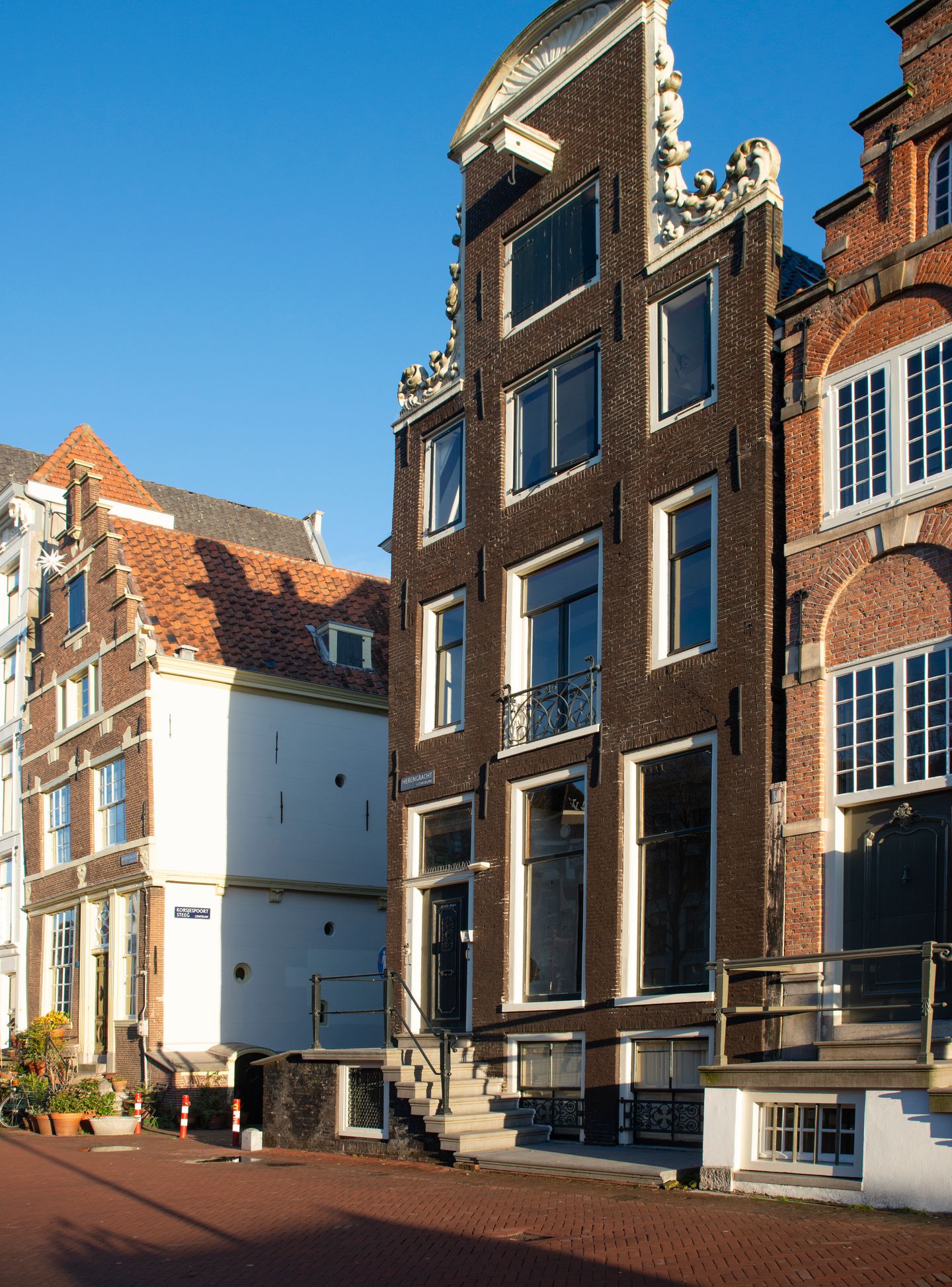
Aan de Amsterdamse Herengracht, en deels in de Korsjespoortsteeg, staat op nummer 79 dit charmante grachtenhuis, aan de rand van de Jordaan. Het is een schoolvoorbeeld van een pand uit 1700, niet groots, wel monumentaal. Een hoekhuis waar het licht van meerdere kanten naar binnen stroomt. Een huis van bijzondere ruimtelijke intimiteit.
Herengracht 79 is gelegen in het deel van de stad dat in 1585 rond de middeleeuwse stad werd aangelegd en bekendstaat als de eerste uitleg. Dit deel van de Herengracht werd aanvankelijk bebouwd met wat kleinere huizen of met de achterhuizen van de panden aan het Singel: deze gracht had toen meer status dan de Herengracht. Toen vanaf 1613 de grachtengordel werd aangelegd, nam de status van de Herengracht toe. In de eeuw erna werden de kleinere panden vernieuwd en vergroot.
Deze ontwikkeling is ook af te lezen aan Herengracht 79. Het eerste huis uit circa 1590 werd rond 1700 geheel of grotendeels vernieuwd, zoals blijkt uit de karakteristieke halsgevel. De gebeeldhouwde klauwstukken vertonen het zogenaamde motief van de doorboorde bloem, dat vaak met de steenhouwer Anthony Turck in verband wordt gebracht. Ook typerend voor die tijd is de variatie van de vensters in de voorgevel met een breder venster in het midden en smallere aan de zijkanten. Bijzonder is de aanwezigheid van een pothuis, het lage deel naast de zijgevel, waardoor het souterrain van het pand ruimer werd.
In het interieur dateert de spiltrap uit de bouwtijd – zie het prachtige uitwaaierende onderste deel van de trap naar de verdieping – evenals de balklagen, de kap met de kreupele spanten en enkele deuren zoals de deur die het trappenhuis op de verdieping afsluit. Makelaar in koren Jan Roelofsz van der Horst was de vermoedelijke opdrachtgever. Amsterdam was in die tijd het graanpakhuis van Europa en zoals zovele stadsgenoten verdiende hij hiermee zijn brood.
In de negentiende eeuw was het pand weer toe aan vernieuwing. Dit is met name te zien aan de schuiframen aan de buitenzijde, de zogenaamde H-ramen, het balkonvenster op de verdieping en veel interieuronderdelen in het souterrain en op de bel-etage.
Indeling van het pand
Het pand heeft een indeling zoals verwacht mag worden van een grachtenhuis. Op alle verdiepingen kan de lift zowel via de nieuw- als de oudbouw worden betreden.
Souterrain
Via diverse ingangen aan de Korsjespoortsteeg bereikt men de hal met toegang tot de trapopgang. Het souterrain beschikt over een voorkamer aan de Herengracht, de keuken en een garage, waarvandaan de lift bereikbaar is. In het pothuis bevindt zich een badkamer en onder de recent vernieuwde stoep een berging. Hier is tevens de toegang tot de gewelfde wijnkelder. De keukeninrichting met de opgehangen luiken, granieto vloer, de witjes, kast en schouw ademt de sfeer van de negentiende eeuw.
Bel-etage
Op de bel-etage vonden de ontvangsten plaats, zoals blijkt uit de ruim vormgegeven suite met hoge plafonds. Via de ingang aan de Herengracht komt men binnen in de hal, al is deze verdieping ook via lift en trappenhuis bereikbaar vanuit het souterrain. Via de van marmer voorziene vestibule betrad men de kleinere zijkamer of de grotere achterkamer (zaal), beide met elkaar verbonden door grote schuifdeuren. De betimmering en de schouw van de zaal stammen uit circa 1870. De schouw heeft een zwartmarmeren onderdeel, vermoedelijk geïmporteerd uit België, met daarboven een boezem met colonetten die een hoofdgestel (kroonlijst) ondersteunen. Achter het nu wat groezelige behang kunnen nog bijzondere behangresten van vroegere tijden tevoorschijn komen. Op deze verdieping bevindt zich ook een gasten WC en een pantry in de nieuwbouw.
Eerste verdieping
Op de eerste verdieping bevindt zich in de huidige vorm een grote ruimte met zicht op de Herengracht en een schouw. De verdieping heeft toegang tot de nieuwbouw met daarin een badkamer en een pantry, en wederom toegang tot het trappenhuis en de lift. De karakteristieke spiltrap met zijn uitwaaierende onderste deel is hier goed zichtbaar. Het uitzicht van de rondomliggende ramen, deels voorzien van een Frans balkon, is adembenemend.
Tweede verdieping
De tweede verdieping biedt wederom een ruime leefruimte met een achterkamer in de nieuwbouw en een badkamer met ligbad, wc en wastafel. Deze verdieping geeft toegang tot de zolderverdieping en het dakterras. De verdieping biedt toegang tot het dakterras, dat een prachtig uitzicht biedt over de omgeving.
Zolderverdieping
De zolder was oorspronkelijk voor opslag bestemd, maar leent zich vandaag uitstekend als slaap- of werkkamer. De verdieping heeft een kamer onder de karakteristieke kap met kreupele spanten.
Ontwikkelpotentieel
Rond 2006 is het pand uitgebreid met nieuwbouw ter plaatse van het oorspronkelijke Korsjespoortsteeg 25. Dit pand was in 1945 gesloopt, waarna de grond in 1951 bij Herengracht 79 werd gevoegd. Later kwam hier een garage te staan, die vervolgens in 2006 is gesloopt en hoger is opgebouwd. Met dit nieuwe deel – dat een eigen ingang heeft – heeft het comfort van de moderne tijd zijn intrede gedaan, onder andere door de aanwezigheid van de lift, die zowel de oud- als de nieuwbouw ontsluit, en de moderne badkamer.
Herengracht 79 is daardoor niet alleen een charmant pand maar ook een dwarsdoorsnede van vier eeuwen geschiedenis en moderniseringen aan de Amsterdamse grachten. De unieke situatie met meerdere ingangen – aan zowel de Herengracht als de Korsjespoortsteeg – biedt bijzonder ontwikkelpotentieel. Deze configuratie maakt het mogelijk om het pand op verschillende manieren te gebruiken: als eengezinswoning, of als combinatie van wonen en werken. De aanwezigheid van de lift, de garage en de moderne uitbreiding vergroot de flexibiliteit aanzienlijk.
De Korsjespoortsteeg
De Korsjespoortsteeg is vernoemd naar houthandelaar Corsgen/Corsgin Jacobzoon die hier in de 15e eeuw een boomgaard had. De bebouwing van de stad hield destijds op bij de (oneven zijde van de) Singel en daar stond een stadspoort die toegang gaf tot de brug over de Singel naar de boomgaard. Corsgin woonde in de toren van de poort en vermoedelijk was hij ook poortwachter. Op de kaart van Amsterdam van Cornelis Anthonisz. uit 1544 komen we de naam Korsjessteeg al tegen en ook de Korsjesbrug is te zien. De brug ligt nog altijd op dezelfde plek.
Alhoewel tegenwoordig midden in de stad heeft deze straat een zeer leefbaar karakter, autoluw en bijzonder kindvriendelijk. Het is hier rustig, in de zomer wordt op straat gegeten en de buurtgemeenschap is hecht. Altijd bijzonder in de zijstraten van de grachten is de schaal van de panden. Het zijn grotendeels nog als geheel bewoonde panden, met twee verdiepingen en een kap en met voorname voorgevels. Vanaf de verdiepingen zijn de bewerkte geveltoppen en pannendaken aan de overkant van de straat goed zichtbaar, wat wonen in deze straat een bijzondere kwaliteit geeft.
__________________________
*** ENGLISH TEXT ***
Herengracht 79 – Corsgens Hoeck aan de Herengracht
Situated on Amsterdam’s Herengracht, and partly on the Korsjespoortsteeg, number 79 is this charming canal house on the edge of the Jordaan. It is a textbook example of a house dating from around 1700: not grand in scale, yet unmistakably monumental. A corner house in which daylight enters from several directions, creating an interior of remarkable spatial intimacy.
Herengracht 79 is located in the part of the city that was laid out in 1585 around the medieval core, known as the First Expansion. This section of the Herengracht was initially developed with smaller houses or with rear houses belonging to properties on the Singel, which at that time enjoyed greater prestige than the Herengracht. When the Canal Belt expansion commenced from 1613 onwards, the status of the Herengracht rose, and over the following century many of the smaller houses were renewed and enlarged.
This evolution can also be read in Herengracht 79 itself. The original house from circa 1590 was wholly or largely rebuilt around 1700, as evidenced by its characteristic neck gable. The sculpted claw pieces display the so-called pierced flower motif, often associated with the stonemason Anthony Turck. Also typical of the period is the variation in window widths across the front façade, with a broader central window flanked by narrower ones. Particularly noteworthy is the presence of a pothuis—the low structure adjoining the side façade—which allowed the basement level to be expanded.
Within the interior, the spiral staircase dates from the original construction period, as does its beautifully flaring lower section leading to the upper floor. Other historic elements include the beam structures, the roof with its crippled trusses, and several original doors, such as the door closing off the stairwell on the upper floor. The presumed client was Jan Roelofsz van der Horst, a grain broker. At the time, Amsterdam functioned as the granary of Europe, and like many of his contemporaries, he earned his livelihood from the grain trade.
By the nineteenth century, the house was again due for renewal. This phase is particularly evident in the exterior sliding sash windows—the so-called H-windows—the balcony window on the principal floor, and many interior elements in both the basement and the bel-etage.
Layout of the Property
The property follows the classic layout expected of an Amsterdam canal house. On all floors, the lift can be accessed from both the historic structure and the later extension.
Basement (Souterrain)
The basement is reached via several entrances from the Korsjespoortsteeg, leading into a hall with access to the main staircase. This level comprises a front room overlooking the Herengracht, the kitchen, and a garage, from which the lift is accessible. The pothuis contains a bathroom, while beneath the recently renewed front steps there is a storage space, which also provides access to the vaulted wine cellar.
The kitchen fittings, with their suspended shutters, granito floor, Delft tiles, cabinetry and fireplace, breathe the atmosphere of the nineteenth century.
Bel-Etage
The bel-etage served as the principal reception floor, as evidenced by the generously proportioned en-suite rooms with high ceilings. Entered via the Herengracht, this floor is also accessible by lift and staircase from the basement. Through the marble-lined vestibule one enters either the smaller side room or the larger rear room (the main reception room), the two connected by large sliding doors.
The panelling and fireplace in the main reception room date from circa 1870. The fireplace incorporates black marble—presumably imported from Belgium—with a mantel supported by colonettes and crowned by a classical entablature. Behind the slightly timeworn wallpaper, earlier decorative layers from previous periods may yet be revealed. This floor also contains a guest WC and a pantry within the newer extension.
First Floor
On the first floor, the current layout consists of a large open space with views over the Herengracht and a fireplace. This level connects to the newer extension, which houses a bathroom and pantry, and again provides access to both the staircase and the lift. The distinctive spiral staircase, with its flaring lower section, is particularly well displayed here. The views from the surrounding windows—some fitted with French balconies—are breathtaking.
Second Floor
The second floor again offers a generous living space, with a rear room in the newer extension and a bathroom fitted with bath, WC and washbasin. This level provides access to the attic floor and to the roof terrace, which offers fine views over the surrounding area.
Attic Floor
Originally intended for storage, the attic now lends itself perfectly to use as a bedroom or study. The space is set beneath the characteristic roof structure with its crippled trusses.
Development Potential
Around 2006, the property was extended with new construction on the site of the former Korsjespoortsteeg 25. This building had been demolished in 1945, after which the land was added to Herengracht 79 in 1951. A garage was later built on the site, which in turn was demolished in 2006 and replaced by a higher structure.
This new section—featuring its own entrance—introduced modern comforts, including the lift serving both the historic house and the extension, as well as contemporary bathroom facilities.
As a result, Herengracht 79 is not only a charming residence but also a cross-section of four centuries of architectural history and modernisation along Amsterdam’s canals. Its unique configuration, with multiple entrances on both the Herengracht and the Korsjespoortsteeg, offers exceptional development potential. The property may be used in various ways: as a single-family residence, or as a combination of living and working. The presence of a lift, garage and modern extension significantly enhances its flexibility.
The Korsjespoortsteeg
The Korsjespoortsteeg is named after the timber merchant Corsgen (or Corsgin) Jacobzoon, who owned an orchard here in the fifteenth century. At that time, the city ended at the Singel (on the odd-numbered side), where a city gate stood, providing access via a bridge over the Singel to the orchard beyond. Corsgin lived in the tower of the gate and was presumably also its keeper.
The name Korsjessteeg already appears on Cornelis Anthonisz.’s 1544 map of Amsterdam, where the Korsjesbrug is also depicted—a bridge that remains in the same location today.
Although now situated in the very heart of the city, the street retains an exceptionally liveable character: quiet, largely car-free and particularly child-friendly. In summer, residents dine outdoors and the sense of community is strong. As is often the case in the side streets of the canal belt, the scale of the buildings is intimate. The houses are largely still occupied as single dwellings, typically with two floors and an attic under a pitched roof, and with dignified façades. From the upper floors, the sculpted gable tops and tiled roofs across the street are clearly visible—an aspect that lends living in this street a very special quality.
Features
Transfer of ownership
- Listed since
- Acceptance
- Available immediately
- Asking price
- € 2,375,000 kosten koper
- Asking price per m²
- € 10,556
- Status
- Under offer
Construction
- Kind of house
- Mansion, corner house
- Building type
- Resale property
- Year of construction
- 1700
- Specific
- Protected townscape or village view (permit needed for alterations), double occupancy possible, heritage listed, listed building (national monument) and monumental building
- Type of roof
- Gable roof
- Accessibility
- Accessible for the elderly
Surface areas and volume
- Areas
- Living area
- 225 m²
- Other space inside the building
- 19 m²
- Exterior space attached to the building
- 18 m²
- Plot size
- 44 m²
- Volume in cubic meters
- 800 m³
Layout
- Number of rooms
- 11 rooms (4 bedrooms)
- Number of bath rooms
- 2 bathrooms
- Bathroom facilities
- 2 showers, walk-in shower, 2 sinks, bath, toilet, and washstand
- Number of stories
- 3 stories, an attic, and a basement
- Facilities
- Alarm installation, french balcony, and elevator
Energy
- Energy label
- Not required
- Insulation
- Roof insulation and partly double glazed
- Heating
- CH boiler
- Hot water
- CH boiler
Cadastral data
- AMSTERDAM M 5446
- Cadastral map
- Area
- 44 m²
- Ownership situation
- Full ownership
Exterior space
- Balcony/roof garden
- French balcony present
Garage
- Type of garage
- Built-in
- Capacity
- 1 car
- Facilities
- Electricity and heating
- Insulation
- Partly double glazed
Parking
- Type of parking facilities
- Paid parking, public parking and resident's parking permits
© 2001-2026 funda