Sold
Korsjespoortsteeg 31015 AP AmsterdamLangestraat e.o.
€ 1,690,000 k.k.

- 174 m²living area
- 74 m²plot size
- 5bedrooms
Sales history
- Listed since
- May 2, 2025
- Date of sale
- July 2, 2025
- Term
- 2 months
Description
The Korsjespoortsteeg derives its name from timber merchant Corsgen/Corsgin Jacobzoon, who maintained an orchard here in the 15th century. The city's development terminated at the Singel's odd-numbered side, where a city gate provided access across the canal to the orchard. Corsgin resided in the gate tower, presumably serving as gatekeeper. The 1544 Amsterdam map by Cornelis Anthonisz already references the Korsjessteeg, depicting the Korsjes Brug, which remains in situ to this day.
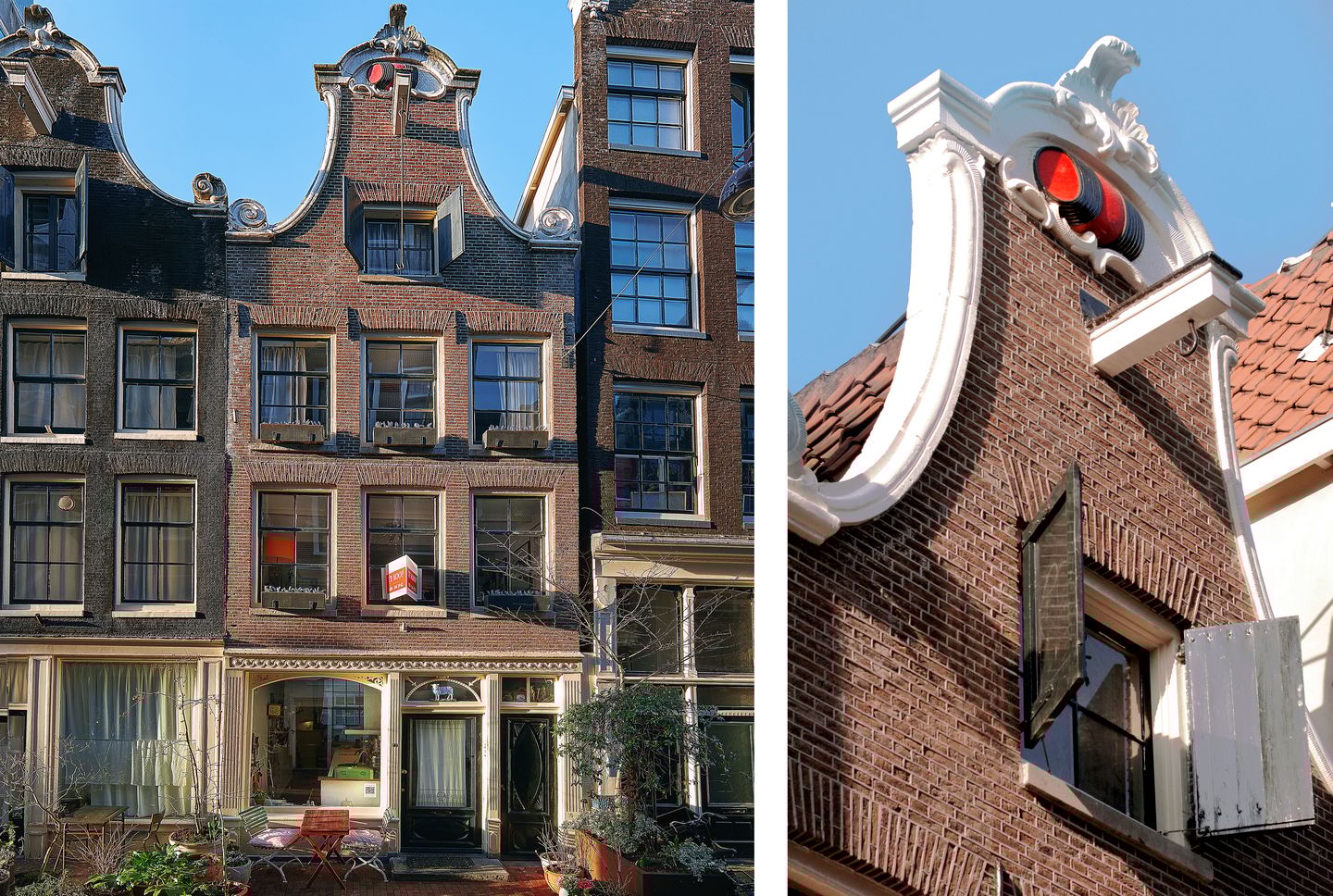
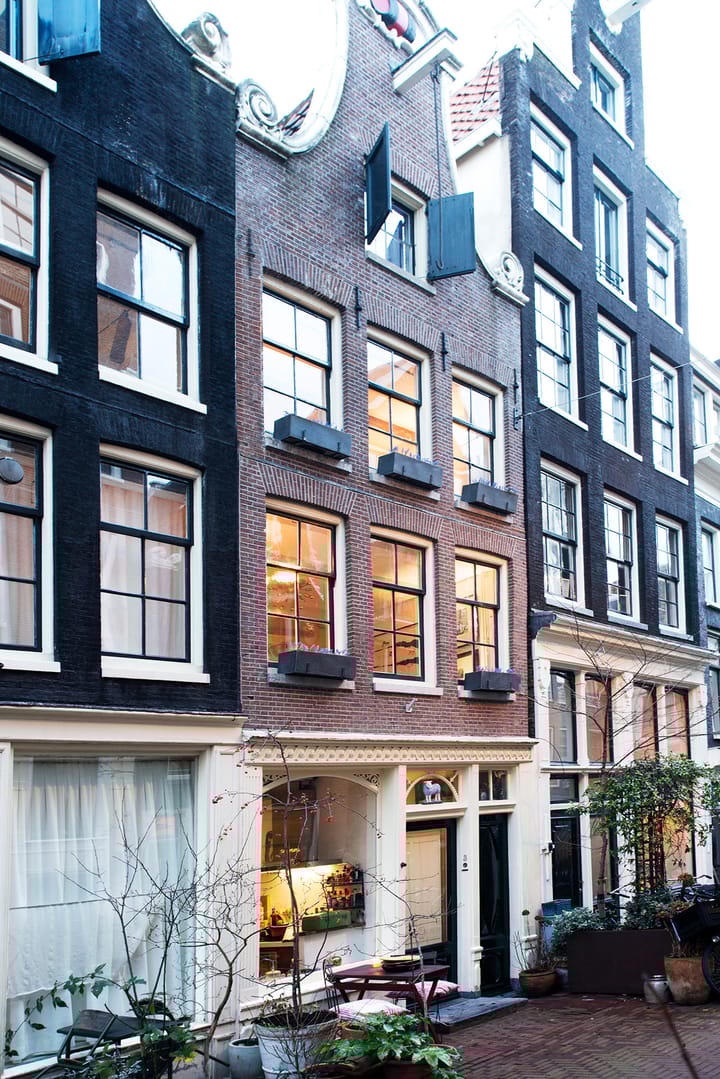
Though now situated in the heart of the city, this street maintains a remarkably liveable character—pedestrian-friendly and particularly amenable to children. Its tranquil atmosphere encourages al fresco dining in summer months, fostering a close-knit community. The canal side streets' architectural scale remains particularly noteworthy. The buildings largely retain their original residential character, featuring two storeys beneath a pitched roof, with distinguished façades. From the upper floors, one can admire the ornate gable tops and tiled roofs across the street, lending a singular quality to residing here.
Number three exemplifies these self-contained dwellings of elegant proportions. In total, over 174 square metres divided between the front and back house with a connecting section. This connecting section was established in 2005 and designed as an octagonal tower with small windows, ensuring there is always daylight around the spacious spiral staircase. The house underwent a complete renovation in 2004-2005, during which all pipes were replaced, asbestos was removed, the layout was changed, and two kitchens and two bathrooms were newly installed. During this renovation, the foundation of the back house was also renewed, with piles being driven in and a concrete slab placed on top, which was embedded into the walls. Earlier, in 1968, the foundation of the front house had already been renewed by means of a concrete floor on foundation beams. The discoveries that emerged during the renovation of the back house, such as the blue and white tiles with illustrations, have been incorporated into the decoration of the spaces.
A pleasant hallway with a wardrobe provides access to the large kitchen-diner on the ground floor. A large table opposite the fireplace with hearth invites gatherings with friends and family. Via the staircase in the connecting section, both the sitting room on the first floor and the floors of the back house are accessible. From the sitting room, a staircase (with beautiful details) leads to the two bedrooms on the second floor in the front house. The unique bathroom with bath is located above, installed under the roof of the front house. The back house contains a bathroom with shower and separate toilet as well as a kitchen on the ground floor, two bedrooms on the upper floors with a roof terrace above. Permission for the roof terrace was granted during the last renovation. An internal staircase must still be installed after purchase, ideally between the beam structure on the second floor of the back house, where historically a staircase has already been situated. Permission has been granted for this.
What truly makes this house special is the interior finishing. With a great deal of love for materials, patina and attention to the existing historical elements, this house has acquired a very distinctive character. Old things are allowed to be and remain old. It has not been smoothed over and fitted with sleek partition walls. What is crooked is crooked and is cherished. The house itself already has beautiful details such as the remnants of the seventeenth-century wooden frame in the front house (the wooden frame style remnant in the kitchen and the beams with the corbels beneath them) which was still recognisable and has been left as is. This indicates a construction period from the seventeenth century, the time of the development of this part of the canal ring. Also note the recognisable trimmer beams in the floor structures where the location of former staircases and smoke flues has remained identifiable. A detail such as the bevelling of the beam in the passageway from the front house to the connecting section is also evidence of this. In the back house, eighteenth-century beams. In any case, the original beam structure has been left visible in all spaces and the rooms are fitted with old interior doors. The rear façade of the front house is clad with wood but seems to protrude on the upper floor relative to the ground floor. This may indicate a 17th-century façade that was often built this way. Probably to prevent rainwater from running down along the façade.
The rear house's history proves fascinating. Loman's 1876 map shows the Korsjespoortsteeg back façades aligned along one building line. The current rear house occupied previously undeveloped land behind Singel 88. Between 1876 and 1944, the single-storey rear house was added, as evidenced by an RCE archive site drawing. By 1978, numbers 1 and 3 Korsjespoortsteeg were unified, though subsequently separated between 1978 and 2004. During the 2004-2005 renovation, the rear house was heightened and connected via the stair tower.
The quality of elements introduced by the current owners is exceptional. All floors feature exquisite wooden flooring; the living room boasts planks of remarkable 40cm width and 430cm length. The ground floor comprises various period tiles of different sizes and eras. Kitchens and bathrooms, though modernly designed, harmoniously blend with historical doors and antique furnishings. Each element merits contemplation. The front house bedroom with its exposed high-pitched roof and the bathroom with its generous shower, bath, and views across to opposite façades deserve particular mention. The calibre of finishing and interplay between historical and contemporary elements creates exceptionally comfortable and intriguing spaces.
Every room offers views through period windows with single glazing, creating simultaneous openness and intimacy. The house feels both cosy and spacious, with playful integration of original and additional elements. It functions admirably as either a family home or as separate front and rear accommodations.
The property is a protected national monument (number 3119), described as: "Building with bell gable (18th century) with carved empire shopfront; doors and transom above shop door". This designation enables advantageous access to residential renovation subsidies from the Cultural Heritage Agency.
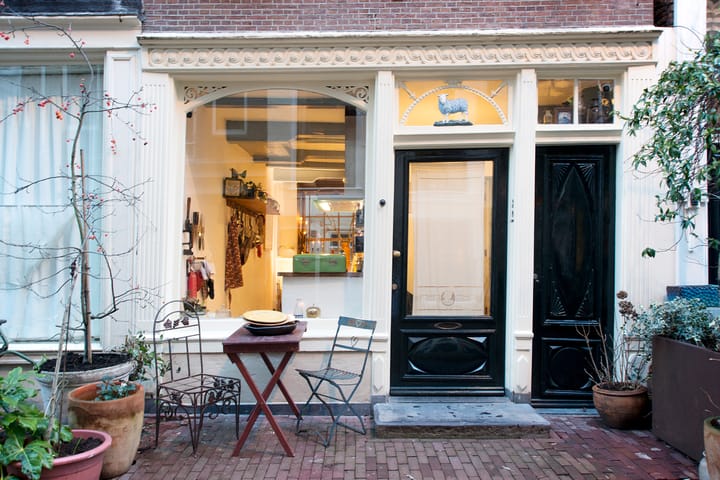
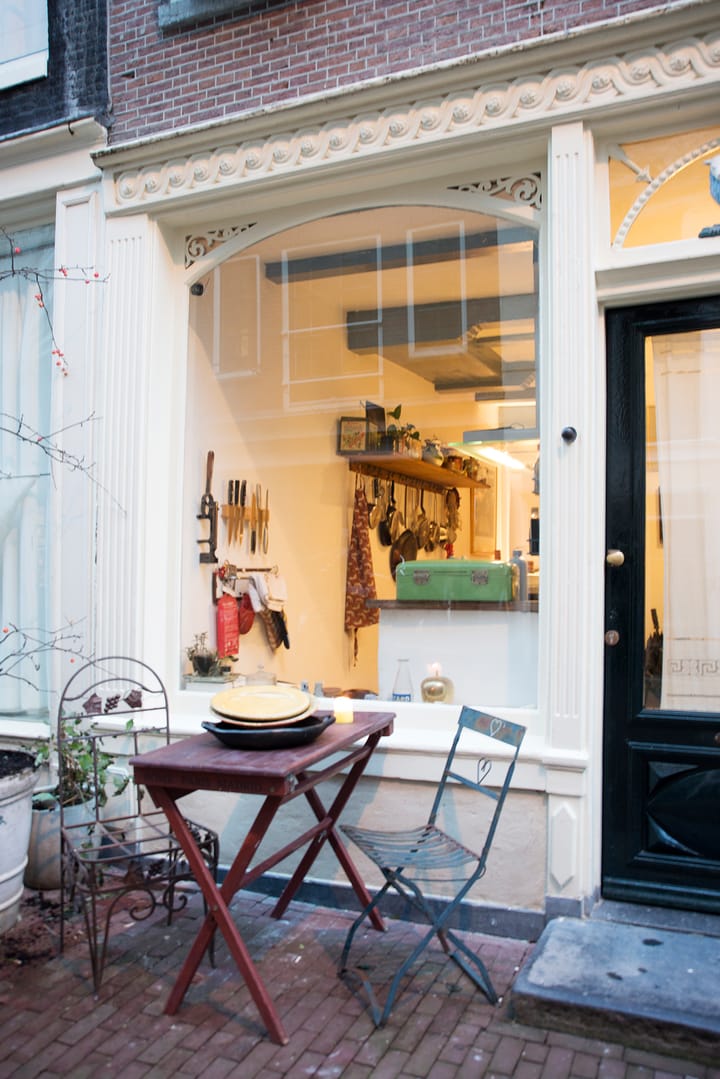
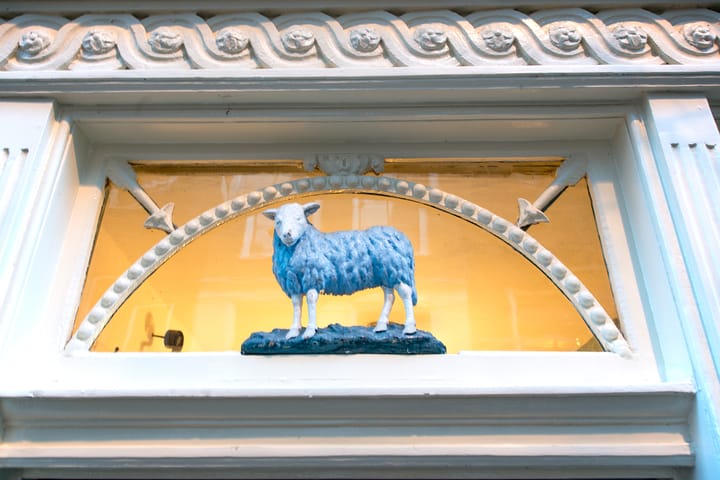
As was common practice, only the façade was modernised in the 18th century according to contemporary fashion and placed before the 17th-century front house. The façade features several notable elements: the ground floor's arch window from its former shop use, the door with elegant mirror panel below and fanlight containing the blue-painted lamb, the upper floor entrance beneath floral-decorated cornicing, six-pane windows on upper floors, and above the shuttered attic window, the bell gable containing the herring stone.
Mid-15th century Amsterdam suffered a devastating fire. Fires proved difficult to control then: Amsterdam houses were predominantly wooden. Consequently, wooden house construction and signage were restricted, leading to stone buildings and the first façade stones. Around 1800, Amsterdam introduced house numbering. Previously, properties were identified by façade stones. These stones served as trade advertisements, referenced builders' names, or indicated owners' origins. They conveyed cultural, economic, religious, and political information. While the herring stone isn't mentioned in the monument registry, possibly added later, it complements all additions to this monument. The result is an extraordinary ensemble in a remarkable urban setting.
Advertisement
Features
Transfer of ownership
- Last asking price
- € 1,690,000 kosten koper
- Asking price per m²
- € 9,713
- Status
- Sold
Construction
- Year of construction
- Before 1906
- Kind of house
- Property alongside canal, semi-detached residential property
- Building type
- Resale property
- Type of roof
- Combination roof covered with asphalt roofing and roof tiles
Surface areas and volume
- Areas
- Living area
- 174 m²
- Exterior space attached to the building
- 17 m²
- Plot size
- 74 m²
- Volume in cubic meters
- 602 m³
Layout
- Number of rooms
- 9 rooms (5 bedrooms)
- Number of bath rooms
- 2 bathrooms and 1 separate toilet
- Bathroom facilities
- 2 showers, walk-in shower, 2 sinks, double sink, bath, toilet, and washstand
- Number of stories
- 4 stories
Energy
- Energy label
- Not available
- Heating
- CH boiler
- Hot water
- CH boiler
Cadastral data
- AMSTERDAM M 5465
- Cadastral map
- Area
- 74 m²
- Ownership situation
- Full ownership
Exterior space
- Patio/atrium
- 9 m² (3 meter deep and 3 meter broad)
- Garden
- Patio atrium
- Patio atrium
- 9 m² (3.00 metre deep and 3.00 metre wide)
- Balcony/roof terrace
- Roof terrace present
Parking
- Type of parking facilities
- Paid parking, public parking and resident's parking permits
Popularity
4,158x
Viewed
90x
Saved
2-5-2025
On Funda
Neighborhood

Langestraat e.o.
Amsterdam- Residents
- 1,890
- Family with children
- 14%
- Avg. asking price / m²
- € 9,088
Discover the neighborhood
Curious about the housing supply, residents and local real estate agents?

Don’t want to forget this home?
Save it as a favorite. You’ll easily find it back and get notified when something changes.
