Lange Wijnen 91251 CE Laren (NH)Steenbergen
€ 2,950,000 k.k.

- 456 m²living area
- 6,000 m²plot size
- 5bedrooms
- Benergy label
Eye-catcherWonen in een Rietveld - Het laatste hoofdstuk van een grote meester
Description
LIVING IN A RIETVELD – THE FINAL CHAPTER OF A MODERN MASTER
ORIGIN OF A MODERNIST DREAM
Woonhuis Bosschaert is a monumental mid-century bungalow in Laren, North Holland, designed in 1963 by world-renowned architect Gerrit Th. Rietveld. This exceptional residence – Rietveld’s final bungalow design – was completed posthumously in 1967 and has since been listed as a national monument due to its exceptional architectural and historical significance.
Situated on a generous, wooded plot on Lange Wijnen 9, the house offers a refined and spacious living experience. It is a vintage design villa with the aura of a work of art, yet the warmth of a true family home. It’s a place for retreat, hospitality, family life or multi-generational living – a rare combination of architectural heritage and daily functionality. The home appeals equally to lovers of mid-century modernism and to those seeking comfort, calm, and centrality in the heart of Het Gooi.
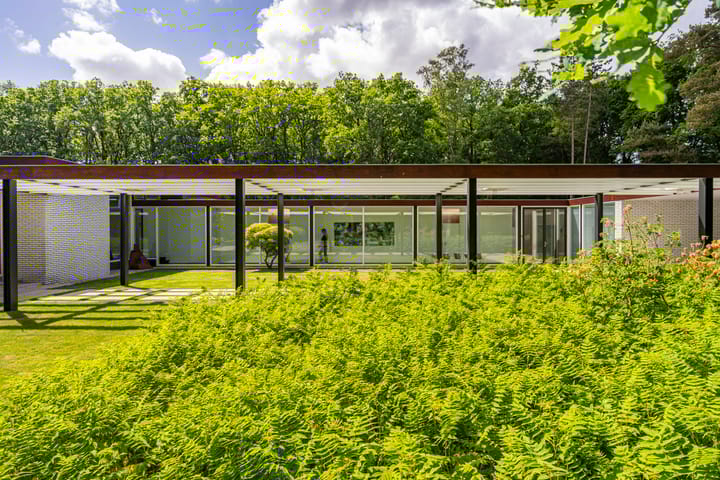
The design is clear and harmonious: large windows, long sightlines, a central patio, and a fully ground-level layout. Its unique story makes this house one of the most important post-war residences in the Netherlands. A place that provides peace, space, and inspiration – every single day.
THE COMMISSION OF ANTON A. BOSSCHAERT
In the early 1960s, lawyer and admirer of modern architecture Anton A. Bosschaert submitted an unusual request to the Royal Institute of Dutch Architects: he sought a designer for a modern country house with four independent residential units. Inspired by American mid-century homes and the styles of Ludwig Mies van der Rohe and Richard Neutra, Bosschaert’s brief was daring, progressive, and visionary.
Rietveld was recommended and took on the assignment. The apartments were to function independently yet form one cohesive architectural entity – a bungalow with the character of a small estate. Rietveld conceived a clear, asymmetrical layout centered around a courtyard, with four units under one roof in a ‘modern motel’ concept: a corridor on one side, rooms on the other, each with full-height glass façades facing the greenery.
RIETVELD’S FINAL DESIGN
Bosschaert’s plan became Rietveld’s last. He passed away in 1964 before construction began. The house was completed in 1967 under the supervision of architects J. van Dillen and later G. Bakker, staying true to Rietveld’s original vision. The result is a bungalow regarded as both a rare surviving example of Dutch late modernist architecture and a defining embodiment of Rietveld’s thinking on living, individuality and shared space. The house holds its own in the company of Neutra, Mies van der Rohe, Le Corbusier, Frank Lloyd Wright – and Rietveld himself.
Internationally, the house stands as Rietveld’s last residential work – a full-scale realization of his spatial and functional ideals. It remains a landmark within the global modernist canon.
LAYOUT – A FLOORPLAN SHAPED BY LIGHT
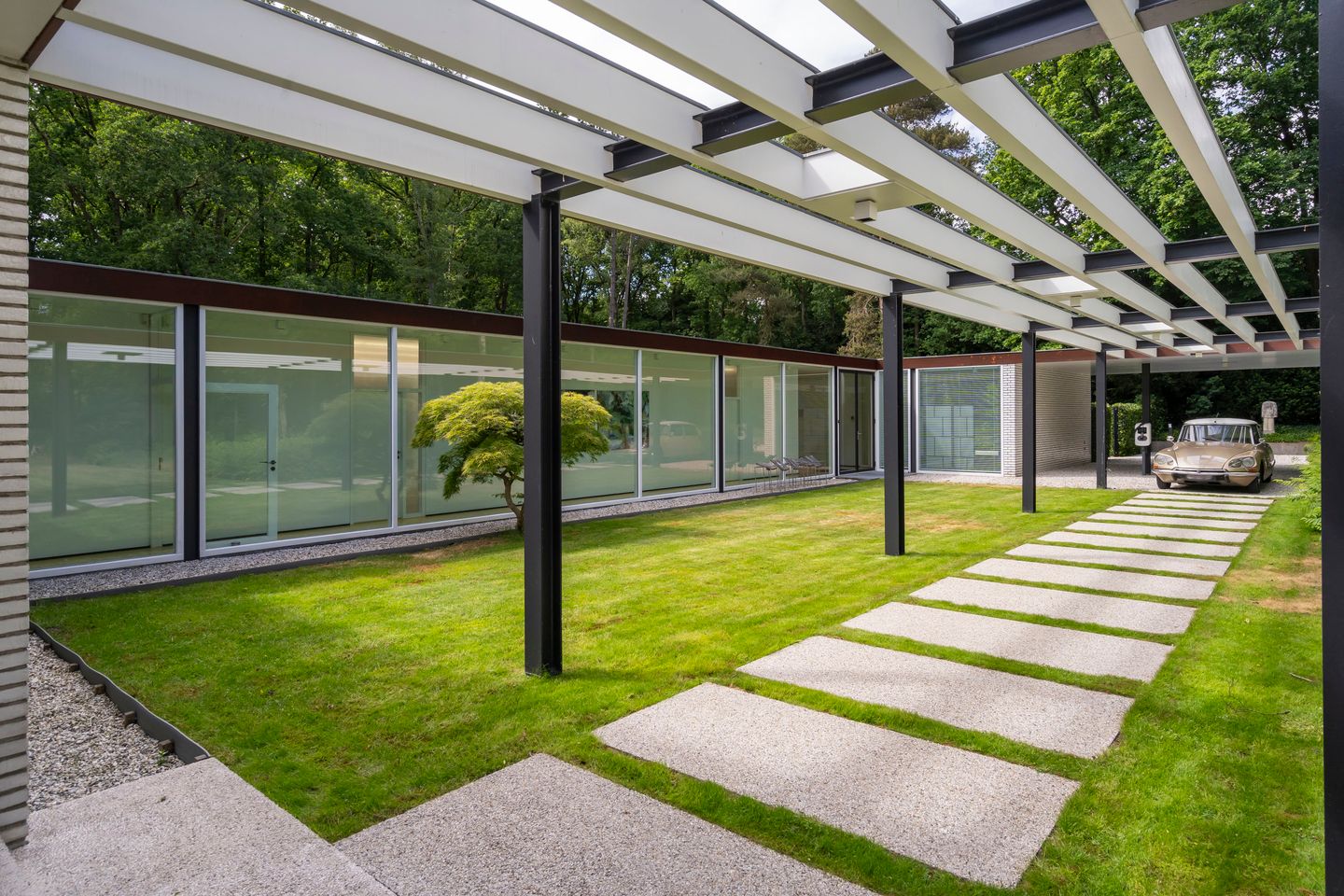
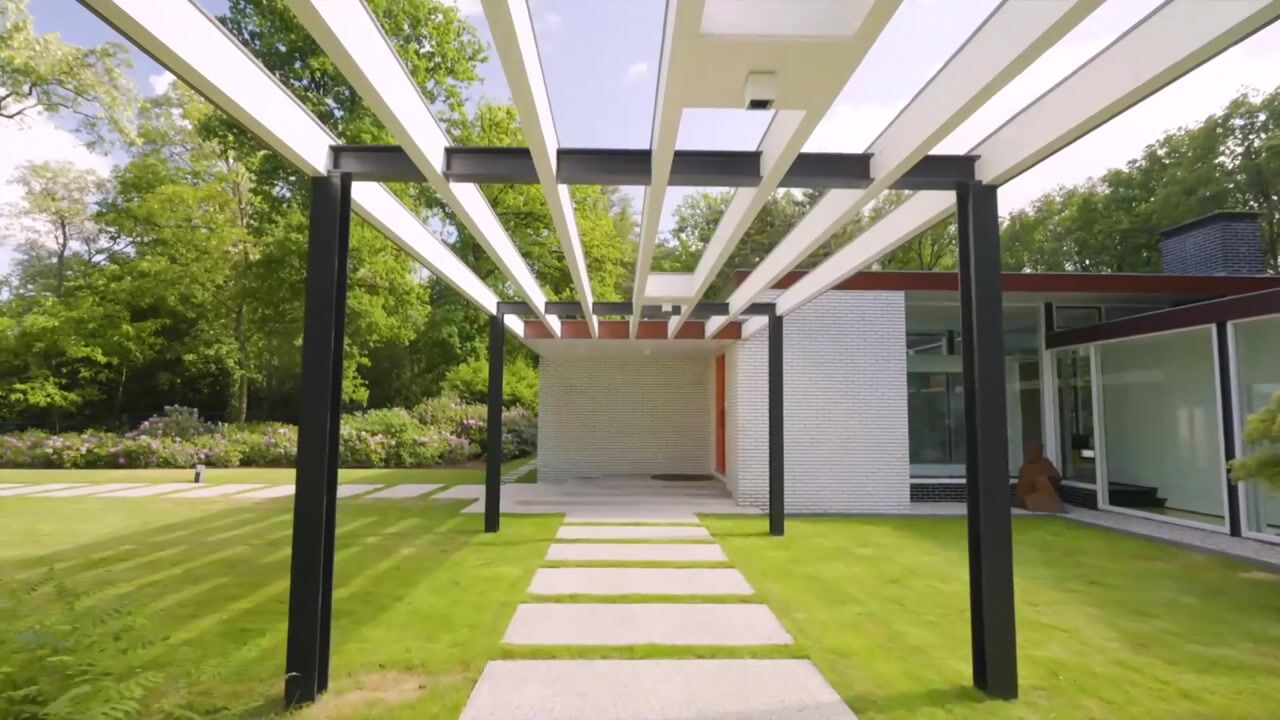
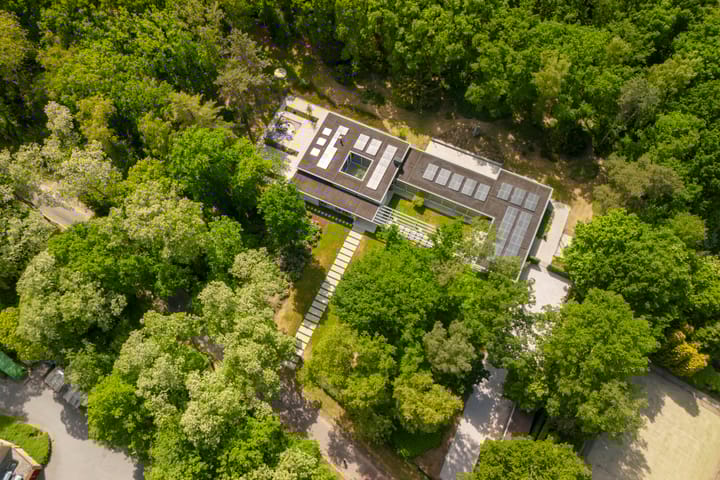
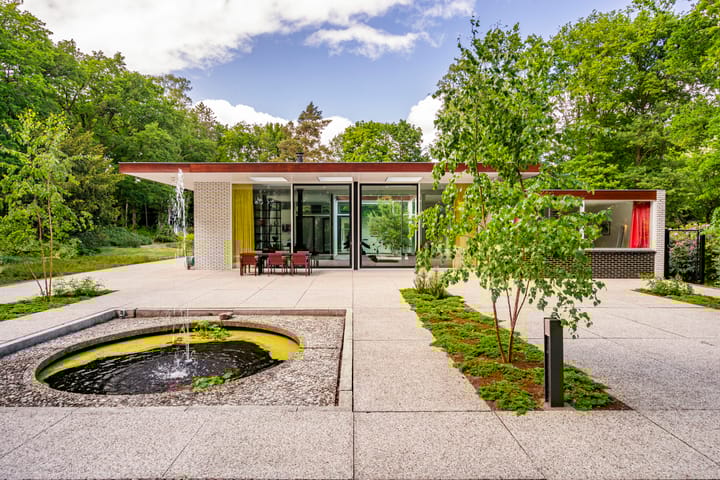
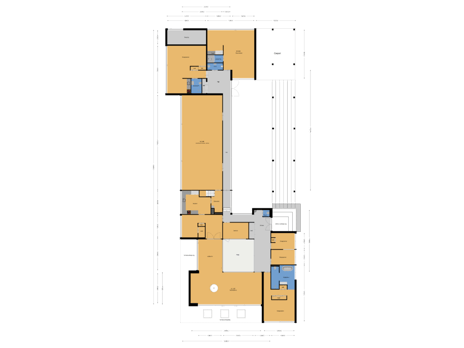
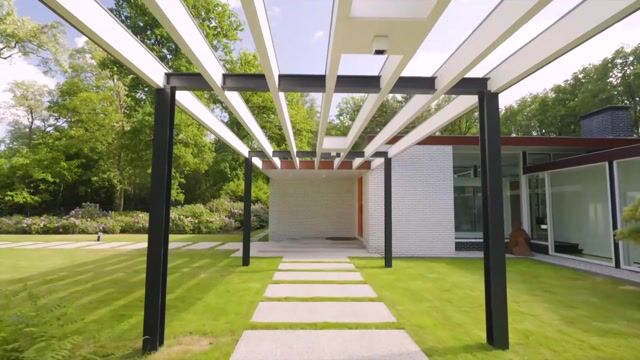
This thoughtfully designed bungalow – approximately 460 m² and entirely on one level – unfolds around a central patio, visible from nearly every room. The house comprises a square main volume with an L-shaped northern wing. Façades are constructed of white and black glazed brick; windows are steel-framed; wide eaves are clad in lacquered cedar. To the east, a striking set of red doors – a Rietveld signature – marks the formal entrance, accessible via the pergola or footpath from Lange Wijnen.
Entrance, Living Room, Dining Room
The entrance hall offers an immediate view of the patio and a direct line of sight into the expansive living room to the south. Full-height sliding glass doors allow a seamless connection to the garden. A floating fireplace and original Rietveld-designed bookcase enhance the domestic atmosphere while respecting the architectural integrity. Adjacent lies the dining room, connected via double doors to a cozy TV lounge on the western side.
Kitchen and Utilities
Extending from the hall is the updated kitchen – contemporary in functionality yet faithful to original proportions and colour schemes. The use of warm yellow subtly references De Stijl’s primary palette. Access to the basement and utility room is also located here.
Bedrooms and Study
A study with peaceful views over the patio sits along the northern edge of the main wing. The master bedroom lies to the south, with built-in wardrobes featuring Rietveld’s signature piano hinges and direct access to a bathroom styled in Nieuwe Bouwen tradition: cleanly tiled, with a freestanding tub, sink unit, walk-in shower, and floating toilet.
Two children's bedrooms on the east side share a sliding wall, fold-away beds by Auping, a collapsible sink, and original Philips Philinea tube lighting – the light switches on when the sink unit opens. These spaces are flexible and highly functional.
Northern Wing – Living, Working, Hosting
Accessible via a secondary hallway off the kitchen, the northern wing offers generous, multifunctional space. A long corridor leads to a large room originally designed as two motel-style units (approx. 45 m² each), now serving as a concert room, event space or salon. This area could easily become a private apartment, guest wing or cultural facility.
At the far end lie two self-contained studios (approx. 45 m² each), each with pantry, living/sleeping area and a compact bathroom in Rietveld’s style. Separate guest WCs are located in the corridor. Ideal for family, guests, or professional use.
A HOUSE THAT ADAPTS
This Rietveld-designed vintage home is not just a spatial sculpture but a truly livable family house. Entirely ground-level, with smooth transitions between inside and outside. To the north are multiple storage rooms and a spacious carport. The floorplan accommodates a variety of lifestyles: a generous family residence, dual living, or shared co-housing – all with privacy and comfort.
GARDEN – A CONTEMPORARY LANDSCAPE WITH HISTORIC ROOTS
The garden is an integral part of the house’s design. Originally laid out by landscape architect Piet Buys and later restored by H+N+S Landscape Architects, it reflects Nieuwe Bouwen ideals: a seamless flow between indoors and outdoors. The garden has two aspects: a front area with architectural structure and rhythm – lawn, pergola, and trees – and a rear that transitions gradually into the surrounding forest.
The patio garden mirrors the wooded atmosphere in a contemplative inner court, while the main terrace features blooming perennials and serves as the central outdoor living space. Large custom gravel tiles replace earlier mismatched paving, reinforcing the original design logic. A subtle fountain adds a quiet focal point. Every element contributes to a seasonal, harmonious and low-maintenance setting.
LOCATION – LAREN AS CONTEXT
Set along a quiet green lane, this home sits near the Rosa Spier Huis – a residential and cultural centre for retired artists and academics. Founded by harpist Rosa Spier, it fosters creativity well into old age. The nearby cultural programme adds depth and vibrancy to the immediate surroundings.
Just around the corner, one finds another form of refined living: a discreet culinary institution beloved in the region – proof that Laren quietly honours tradition, style and taste.
Though centrally located, the house is hidden from the public eye. A long drive and wooded surroundings provide seclusion. Within this context, the house nestles into the landscape without losing its modern identity – in line with Het Gooi’s tradition of villas: modern in form, natural in setting.
INTERIOR & MATERIALS – CONTINUITY & CRAFT
When the current owners purchased the house in 2016, it required substantial restoration. Van Hoogevest Architecten – known for projects such as the Rijksmuseum – oversaw a meticulous renovation. Interior architect Maurice van Bakel reinterpreted Rietveld’s built-in furniture, colours and lighting.
Original materials and finishes have been preserved or restored: wengé parquet floors, custom cabinetry, and expansive glass create strong sightlines and abundant natural light. The layout remains highly adaptable for shared or multi-generational living.
A MODERNIZED MONUMENT
Since its acquisition, the home has been updated throughout. Old materials were replaced with seamless, colourfast finishes. Outbuildings were adapted for cultural use, and a new forecourt extends the architectural geometry. Technically, the house is future-proof: gas-free, equipped with quiet heat pumps, HR++ glass, floor insulation, warm roof structure and 90 solar panels – invisible from the road. The building’s installations are integrated discreetly, ensuring a calm, efficient living climate.
RESTORATION & ENERGY STRATEGY
Led by Van Hoogevest, the renovation balanced heritage and performance. Heating and hot water are delivered by air-to-water heat pumps located away from the façade to preserve visual integrity. Floor heating is installed throughout; areas with original wengé flooring use discreetly integrated convectors. Passive cooling is possible but rarely needed thanks to the insulation and shaded setting. The result: energy label B – extraordinary for a protected monument of this scale.
FUTURE USE
The home is ideally suited for a family, multi-generational living or shared housing concept – for example, four or five private units with shared amenities. The layout supports cultural, educational or community use – aligned with the Rosa Spier Huis model where living and creating go hand in hand. Rietveld envisioned flexible living, and this house is ready to fulfil that vision anew.
HERITAGE STATUS
The home’s national monument designation reflects its unique status as Rietveld’s final completed residential design, its authentic preservation, and its innovative layout – a modernist estate with individual studios in a bungalow format.
Yet it’s no museum. This is an architectural gem designed to be lived in – practical, refined, and timeless. A three-star restaurant, but for those with a taste for proportion, calm and clarity. A livable work of art.
IN SHORT – A MODERNIST MASTERPIECE TO LIVE IN
This is no static showpiece. It’s designed for daily life – practical, expressive, and enduring. Rietveld’s final work is a powerful example of what modern architecture can be: clear, humane, and still profoundly relevant. A landmark for those who truly understand architecture – and for those who seek more than floorplans alone. It’s a home where light follows life, where simplicity becomes luxury, and where the hand of a great master is present in every line, transition and silence. A house to inhabit, to share, and to treasure.
Advertisement
Features
Transfer of ownership
- Listed since
- Acceptance
- Available in consultation
- Asking price
- € 2,950,000 kosten koper
- Asking price per m²
- € 6,469
- Status
- Available
Construction
- Kind of house
- Villa, detached residential property
- Building type
- Resale property
- Year of construction
- 1963
- Specific
- Double occupancy possible and monumental building
- Type of roof
- Flat roof covered with asphalt roofing
Surface areas and volume
- Areas
- Living area
- 456 m²
- Other space inside the building
- 34 m²
- Exterior space attached to the building
- 103 m²
- Plot size
- 6,000 m²
- Volume in cubic meters
- 2,007 m³
Layout
- Number of rooms
- 11 rooms (5 bedrooms)
- Number of bath rooms
- 3 bathrooms and 1 separate toilet
- Bathroom facilities
- 3 showers, double sink, walk-in shower, bath, 2 toilets, and 2 sinks
- Number of stories
- 1 story
- Facilities
- Air conditioning, alarm installation, optical fibre, mechanical ventilation, passive ventilation system, flue, sliding door, and TV via cable
Energy
- Energy label
- B
- Insulation
- Completely insulated
- Heating
- Wood heater, complete floor heating and heat pump
- Hot water
- Electrical boiler
Cadastral data
- LAREN C 1101
- Cadastral map
- Area
- 6,000 m² (part of parcel)
- Ownership situation
- Full ownership
Exterior space
- Location
- Sheltered location, in wooded surroundings and unobstructed view
- Garden
- Surrounded by garden
Storage space
- Shed / storage
- Built-in
- Facilities
- Electricity and running water
- Insulation
- Completely insulated
Garage
- Type of garage
- Carport, possibility for garage and parking place
Parking
- Type of parking facilities
- Parking on private property
Popularity
25,840x
Viewed
413x
Saved
20-6-2025
On Funda
Neighborhood

Steenbergen
Laren (NH)- Residents
- 24,567
- Family with children
- 32%
- Avg. asking price / m²
- € 7,285
Discover the neighborhood
Curious about the housing supply, residents and local real estate agents?

Don’t want to forget this home?
Save it as a favorite. You’ll easily find it back and get notified when something changes.
